
Table of Contents
ToggleA square bathroom presents a unique challenge and opportunity for homeowners and DIY enthusiasts. Unlike rectangular spaces that naturally flow in one direction, a square layout demands thoughtful planning to avoid wasted corners and awkward traffic patterns. The good news: with smart fixture placement and strategic design choices, a square bathroom layout can actually be easier to work with than you’d think. This guide walks you through the principles, popular floor plans, and practical tips to transform your square space into a functional, stylish room you’ll love using every day.
Key Takeaways
- A square bathroom layout offers natural symmetry and straightforward traffic flow, making it easier to work with than linear spaces when fixtures are placed strategically.
- Always concentrate wet zones (toilet, sink, shower, tub) on the same wall to minimize plumbing costs and simplify future maintenance.
- Popular square bathroom floor plans include the Galley Layout for compact 5’×5′ to 6’×6′ spaces, the L-Shaped Plan for 7’×7′ bathrooms, and the Symmetrical Plan for larger 8’×8’+ spaces.
- Small square bathrooms require vertical storage, light colors, glass shower enclosures, and strategic fixture choices like corner sinks or compact toilets to maximize usable space.
- Tile patterns, quality hardware finishes, and proper lighting—including wall sconces flanking mirrors and dimmer switches—transform a square bathroom layout from functional to stylish.
- Respect IRC clearance standards: 15 inches from the toilet center line to walls and 24 inches of floor space in front of vanities to avoid cramped, unusable designs.
The Advantages of Square Bathroom Design
Square bathrooms get overlooked, but they offer real advantages when planned correctly. First, symmetry works in your favor, a square footprint naturally invites balanced, mirror-image layouts that feel intentional rather than haphazard. This means you can flank the vanity with matching sconces, position a toilet and bidet symmetrically, or create dual storage on opposite walls without forcing the design.
Second, traffic flow is straightforward. You’re not trying to navigate a long hallway-like space where the toilet blocks access to the shower. People enter, move through, and complete their tasks in a contained zone. This is especially valuable in smaller bathrooms (5′ × 5′ to 7′ × 7′) where every inch counts.
Third, square bathrooms are easier to tile and wallpaper. Fewer corners and angles mean less cutting, less waste, and faster installation, a real win if you’re tackling the project yourself. The symmetry also makes tile patterns pop, whether you’re running a herringbone, subway, or geometric design.
Essential Layout Principles for Square Bathrooms
Start with the golden rule: place wet zones (toilet, sink, shower, or tub) on the same wall when possible. This concentrates plumbing runs, cuts installation costs, and makes maintenance easier down the road. Align fixtures vertically rather than spreading them across the room, which wastes floor space.
Next, respect the entry point. Position the toilet where visitors can’t see it directly from the door, a simple courtesy that also opens up the visual space. The sink ideally sits near the entry for quick hand-washing without navigating through the core of the room.
Think about ventilation and natural light. If your square bathroom has one window, place the vanity or toilet opposite it to maximize daylight on your face during morning routines. Ensure your exhaust fan placement aligns with your layout: you’ll want it pulling moisture from the shower area most actively.
Finally, consider clearances. A toilet needs at least 15 inches from the center line to a wall (IRC standard). A toilet and bidet side-by-side should be 30 inches minimum between center lines. A standard vanity is 30 to 36 inches wide: allow 24 inches of floor space in front for comfortable use. These clearances prevent layouts that look good on paper but feel cramped in reality.
Choosing the Right Fixture Placement
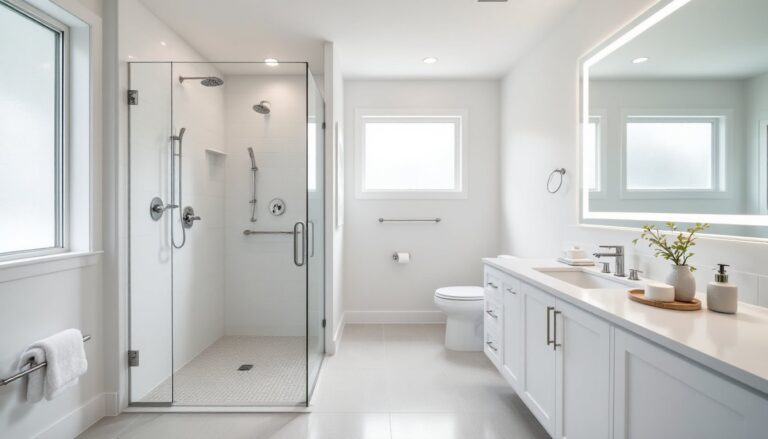
In a square bathroom, fixture placement makes or breaks the design. The shower or tub is your anchor, it’s the largest element and hardest to move. If possible, place it in a corner or along one wall, never in the center of the room. Corner placement saves wall space and creates a sense of enclosure, making the shower feel like its own zone.
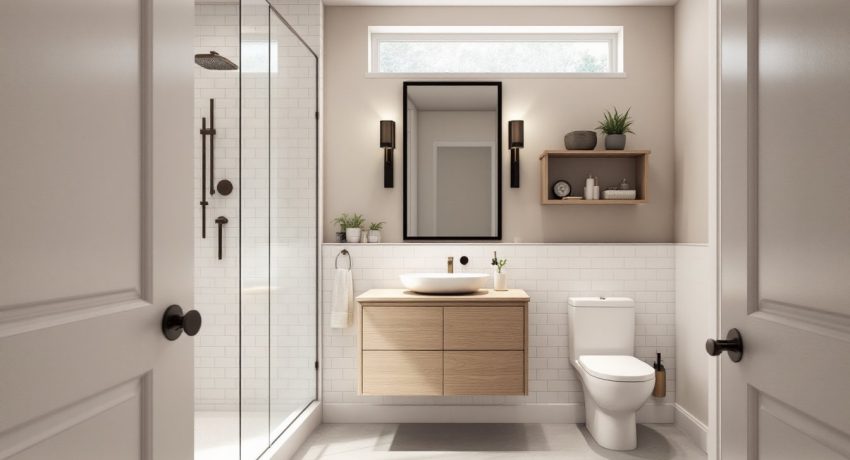
The vanity deserves the best natural light and the most accessible location. Near the entry is ideal unless you have a second door or window elsewhere. A floating vanity (mounted 12 to 15 inches off the floor) visually expands tight spaces and makes cleaning underneath easier.
The toilet goes to the least visible wall, tucked beside the shower or opposite the vanity. If your square bathroom is tiny, a corner toilet works, but ensure you have a wall or partition to provide privacy and visual relief.
Popular Square Bathroom Floor Plans
The Galley Layout is common in 5′ × 5′ to 6′ × 6′ spaces. The vanity and toilet sit on opposite walls, with the shower tucked into a corner. This creates a clear path down the middle of the room and feels less cramped than a true corner-heavy design.
The L-Shaped Plan works beautifully for 7′ × 7′ bathrooms. Place the vanity along one wall and the toilet on an adjacent wall, with the shower claiming a corner. This setup maximizes corner usage and leaves the fourth wall open for storage cabinets, a second vanity, or simply breathing room.
The Symmetrical Plan suits larger square bathrooms (8′ × 8′ or more). Center the toilet and place matching vanities on opposite walls, with the shower or tub on the remaining wall. It’s formal and balanced, perfect if you want a spa-like or designer feel. You’ve probably seen this in hotels and high-end homes, for good reason.
The Corner Shower Plan works in almost any square bathroom. Tuck a corner shower (neo-angle glass enclosures save space), place the vanity centrally or to one side, and position the toilet on a third wall. This leaves one wall completely open for a small cabinet, decor, or future modifications.
Each plan works at different scales, and your existing plumbing location often dictates which is most practical. Rough-in work, moving supply lines and drain stacks, is expensive, so existing plumbing positions should heavily influence your choice.
Making the Most of Limited Space
Small square bathrooms need every trick in the book. Vertical storage is non-negotiable: install shelves above the toilet, use wall-mounted cabinets, and add a medicine cabinet with mirrored doors. A mirror reflects light and doubles the apparent size of the room, a simple but powerful illusion.
Choose fixtures and finishes strategically. A corner sink or pedestal sink saves floor space compared to a vanity, though you sacrifice storage. A combined toilet-bidet or a compact toilet (around 24 inches deep instead of standard 28 inches) reclaims floor space. A shower stall beats a tub if you rarely soak: a soaking tub makes no sense in a 5′ × 5′ bathroom.
Light colors (white, light gray, soft beige) reflect light and feel more spacious. A single accent wall in a darker tone adds character without overwhelm. Glass shower enclosures keep sightlines open, whereas tile showers with partial walls create visual division.
Keep surfaces clear. Open shelving is trendy but only works if items are neatly organized. Use drawer dividers, labeled bins, and vertical stackable storage to stay tidy. Clutter eats space faster than any design choice.
Consider layout flexibility. A pocket door saves the swing space of a traditional hinge door. A toilet tank that mounts to the wall (concealed tank) saves precious floor depth. These small choices compound into a bathroom that actually feels spacious.
Design Tips to Enhance Your Square Bathroom
Once your layout is locked, design choices elevate the space. Tile patterns matter more in square bathrooms because of the symmetry. A herringbone or chevron pattern draws the eye diagonally, making the space feel larger. Subway tile laid vertically on shower walls adds height. A large-format tile (12″ × 24″ or bigger) minimizes grout lines and makes tight spaces feel less busy.
For inspiration and real-world examples, Remodelista offers curated bathroom design ideas and product guides that can spark your own project approach. Professional photos show how successful designers handle square layouts across different budgets.
Consider hardware and fixtures as design anchors. Matte black or brushed brass faucets and towel bars are timeless and coordinate with most tile and paint choices. Avoid cheap-feeling finishes: quality fixtures last decades and feel like intentional design, not afterthoughts.
Lighting transforms the space. Recessed lights centered in the ceiling create even illumination, while wall sconces flanking the mirror add flattering, task-focused light. A dimmer switch lets you adjust mood, bright for morning routines, softer for evening wind-down.
Understanding renovation costs and timelines helps manage expectations. Tools like ImproveNet provide cost guides and contractor resources, so you can budget for both DIY and professional work (like plumbing or electrical rough-in).
Final touches: a single plant or carefully chosen décor items add personality without clutter. A good exhaust fan and proper ventilation prevent mold and mildew, which trash even beautiful bathrooms. Install it with dampers to prevent back-drafts, and run it during and 20 minutes after showers.
For specific layout challenges, community forums like Houzz discussions on square bathroom layouts provide real homeowner insights and solutions you can adapt to your own space.
Conclusion
A square bathroom layout isn’t a constraint, it’s an opportunity to build a balanced, efficient space. By anchoring wet zones, respecting clearances, and choosing fixtures that fit your footprint, you’ll create a bathroom that flows naturally and feels intentional. Start with a solid layout plan, commit to smart fixture placement, and let design choices amplify what you’ve built. With thoughtful planning and honest assessment of your skills, a square bathroom remodel becomes a rewarding project you’ll enjoy for years.