

Table of Contents
ToggleA home theater receiver is the backbone of any serious audio and video setup, it’s the hub that powers your speakers, decodes surround sound, and connects all your devices. Without the right receiver, even expensive speakers and displays fall flat. Whether you’re building your first system or upgrading an aging setup, choosing the right receiver comes down to understanding what features actually matter for your space and listening habits. This guide breaks down what makes a receiver work, which features justify their cost, and where to find solid options across all budget levels.
Key Takeaways
- A home theater receiver is the central hub that amplifies audio, decodes surround formats like Dolby Atmos, and switches video signals from all your devices in one integrated package.
- Match your receiver’s power output to your room size: 60–80 watts per channel works for smaller rooms, while medium spaces need 80–100+ watts to drive speakers adequately without strain.
- Choose your channel configuration based on room layout—a properly placed 5.1 setup outperforms a poorly integrated 7.1 system, so prioritize correct speaker placement over channel count.
- Post-2020 receivers universally support Dolby Atmos and DTS:X immersive formats, making them standard features; prioritize HDMI 2.1 ports, ARC/eARC connectivity, and wireless streaming (AirPlay, Chromecast) as essential modern features.
- Budget-tier receivers ($400–500) deliver honest performance with Atmos and 4K passthrough, while mid-range options ($700–1,200) add room correction and 4K 120Hz gaming support—premium models ($1,500+) justify their cost only for critical listening setups.
- Used receivers from 2018–2021 offer exceptional value at 40–50% less than new models while maintaining full support for current audio formats and video standards.
What Is A Home Theater Receiver And Why You Need One
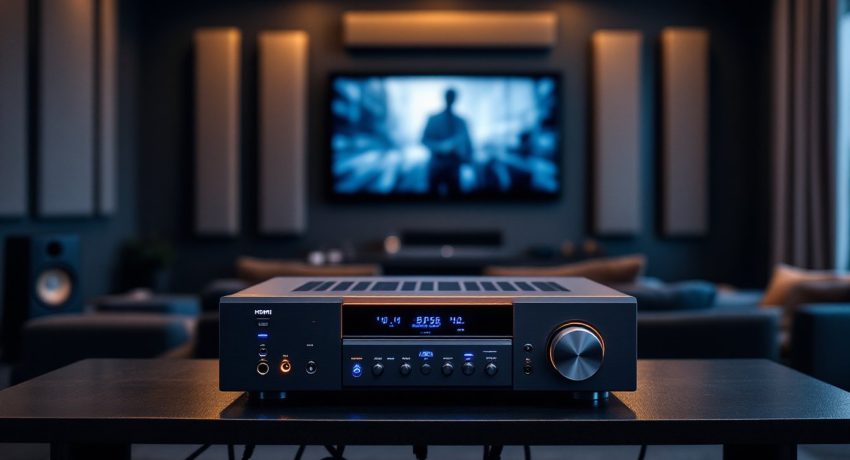
A home theater receiver (or AV receiver) is a single box that combines an amplifier, audio decoder, video switcher, and tuner in one unit. It takes signals from your cable box, streaming device, or gaming console, decodes the surround sound format, amplifies the audio to your speakers, and passes video through to your display.
You could technically build a system without one, using a separate preamp, amplifier, and switcher, but a receiver handles all that in a compact, integrated package. It’s the master controller that makes everything talk to each other. Most modern receivers also handle 4K video passthrough, wireless streaming, and voice control integration, making them more than just amplifiers.
The core reason you need one: it processes surround formats like Dolby Atmos and DTS:X, driving multiple speakers at adequate levels. A receiver rated at 100 watts per channel into 8 ohms can handle a typical 5.1 or 7.1 setup in a medium room without strain. Without that amplification and decoding capability, you’re stuck with stereo or external amplifiers wired separately, doable, but far more complicated.
Key Features To Consider When Choosing A Home Theater Receiver
Not every receiver feature matters for every room. Focus first on power, channels, and audio formats, the essentials that directly affect sound quality. Secondary features like apps and convenience options matter less if the core performance isn’t there.
Start by measuring your room and counting speaker positions. A 5.1 setup (left, center, right front speakers plus a subwoofer and one surround) works for rooms under 250 square feet. Larger spaces or rectangular rooms benefit from 7.1 (adding a second surround pair). Atmos-capable receivers add height channels for immersive overhead sound, but that’s a refinement most people add later, not upfront.
Power Output And Channel Configuration
Power ratings matter, but they’re easy to misread. Manufacturers list watts per channel, but context is everything. A receiver rated 100W x 7 @ 8 ohms means 100 watts into each of seven channels at 8 ohms (standard speaker impedance). That same receiver might claim 150W x 7 @ 4 ohms, higher power but under more stressful conditions. Real-world rooms don’t use theoretical specs: trust the 8-ohm rating.
For speaker sensitivity (how loud they play at a given power level), a 87 dB rated speaker in a treated room 10 feet away will play adequately at 50–70 watts. Go quieter or farther back, and you’ll want 100+ watts per channel. In smaller rooms, 60–80 watts per channel is plenty. The honest math: underpowering is more common than overpowering. Buying a receiver with 20% more power than you think you need is safe and costs minimal extra.
Channel count is simpler. Pick 5.1, 7.1, 7.1.4 (adding Atmos height channels), or 9.1.2 if your room layout supports it. More isn’t always better, a properly placed 5.1 system sounds better than a poorly integrated 7.1.
Audio Format Support And Connectivity Options
Every receiver made after 2020 handles Dolby Atmos and DTS:X, the immersive formats that add height and object-based panning. Both are now standard, not premium features. If you stream movies, Dolby Atmos-capable receivers unlock a notch of immersion that regular 5.1 can’t touch. DTS:X is less common in streaming but standard on 4K Blu-rays.
Connectivity is divided into analog and digital. You’ll need multiple HDMI 2.1 ports (for 4K 120Hz support on gaming consoles) and at least one optical or coaxial digital input for older devices. ARC/eARC ports let your TV send audio back to the receiver without a separate cable, standard on modern sets, invaluable for simplifying cable runs.
Wireless options like AirPlay 2, Chromecast, and Bluetooth are now baseline expectations, not upgrades. They make streaming music trivial. Some receivers add Roon or Tidal app support directly, which cuts out an extra device. That’s convenience, not necessity, but worth a thought if you use those services.
Top Receivers For Different Budgets And Needs
Budget-tier receivers under $400–500 handle 5.1 or 7.1 audio, support Atmos, and deliver 70–90 watts per channel. Brands like Denon, Yamaha, and Onkyo all ship solid entry models here. They decode every modern format and pass 4K video without issue. You lose HDMI 2.1 gaming features and some app integration, but core performance is honest. Real-world example: a Denon S760H (2020 model, often discounted) runs 5.1 or 7.1, does Atmos and DTS:X, and costs $350–400 used. It won’t look fancy in a rack, but it works.
Mid-range receivers ($700–1,200) add HDMI 2.1 inputs for 4K 120Hz, more processing power for room correction, and better build quality. A Yamaha RX-A3700 or Denon AVR-S970H lands here. They include Audyssey or YPAO, auto room calibration that measures your space and adjusts EQ curves. That’s worth real money if your room has bass modes or absorptive materials. Brands like Tom’s Guide and CNET regularly compare receivers in this range.
Premium models ($1,500+) add better amplification, more inputs, and wireless subwoofer management. A Denon AVR-X7500H or Onkyo TX-RZ3100 delivers 110–150 watts per channel with tighter bass control. They’re not necessary for most rooms, but if you’re running nine speakers or optimizing for critical listening, the extra headroom and processing matter. Digital Trends frequently reviews high-end receivers alongside smart home integration features.
For budget-conscious setups, used receivers from 2018–2021 are bargains. They handle Atmos, decode all modern formats, and cost 40–50% less new. Check return policies, buy from sellers with strong ratings, and verify remote inclusion. A 5-year-old Denon or Yamaha still outperforms a bottom-tier current model.
Conclusion
Your receiver is an investment that directly shapes how you experience movies, music, and games. Start with power and channels that match your room size, add Atmos support if you plan to scale, and pick a brand with reliable service (Denon, Yamaha, Onkyo, and Pioneer all stand behind their gear). Don’t chase unnecessary specs: a $500 receiver with honest 80 watts per channel beats a $800 model overstuffed with features you’ll never use. Buy once, buy smart, and your system will reward you for years.